Effects
30 effects
Dynamics
-
 Compressor
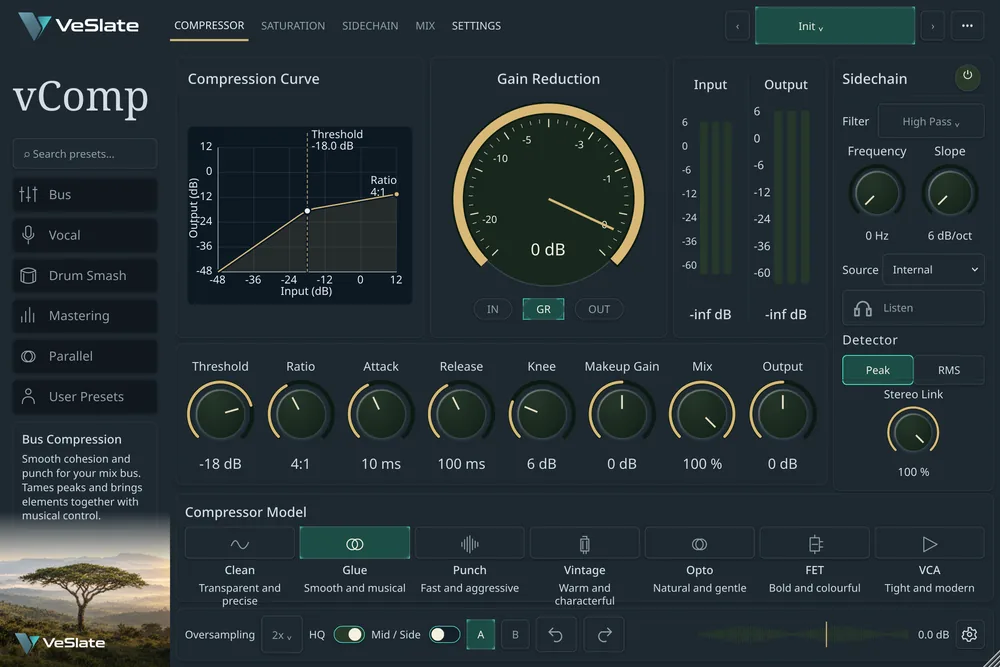
Reduces the level of signal above a threshold, with ratio, knee, attack, release, lookahead, makeup gain and high-pass and low-pass filters on the detector. Its modes are compressor, upward expander, gate and de-esser, the detector reads peak or RMS, and the key can come from an external input.
-
 Limiter
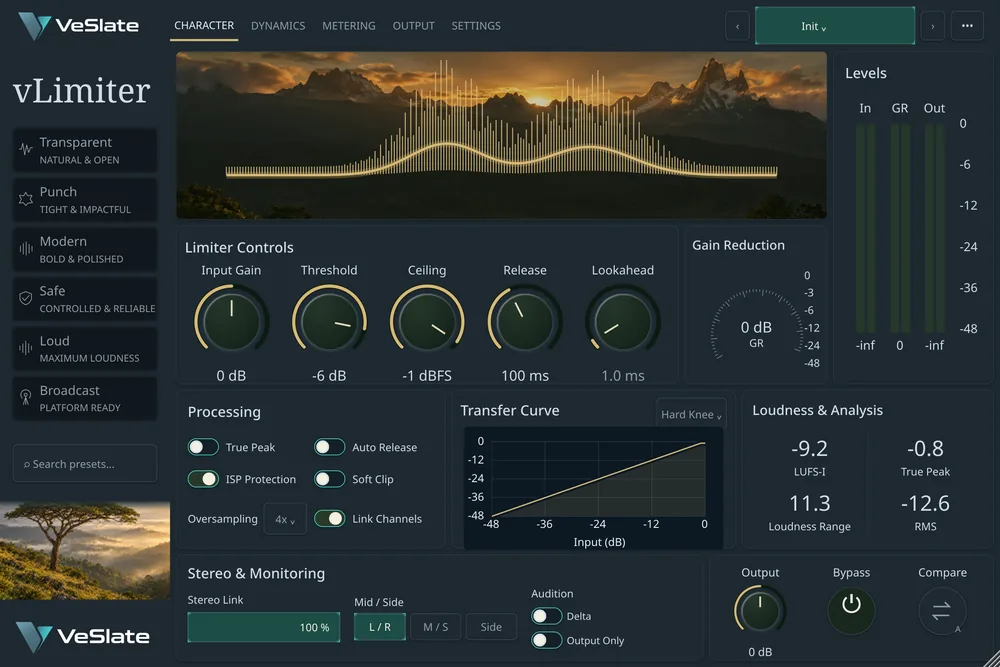
Keeps the output below a ceiling you set, using a fixed 5 ms lookahead, an input drive, release and an output trim, with a hard or soft knee. Detection can run on the samples or on a 4x reconstruction of the waveform, and it has an automatic release, a soft clip and a mode that outputs what the limiter removed.
-
 Gate
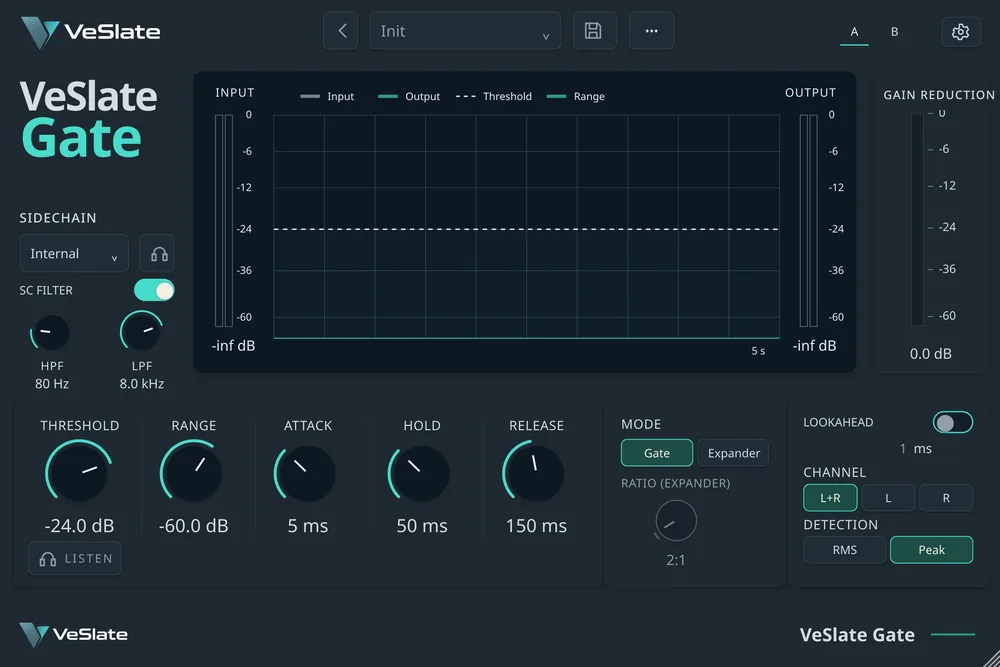
Closes the signal below a threshold as a gate or as a downward expander, with hysteresis, attack, hold, release, range and lookahead. The detector reads the left and right channels together or one of them, can be filtered, and can follow an external input.
-
 DeEsser
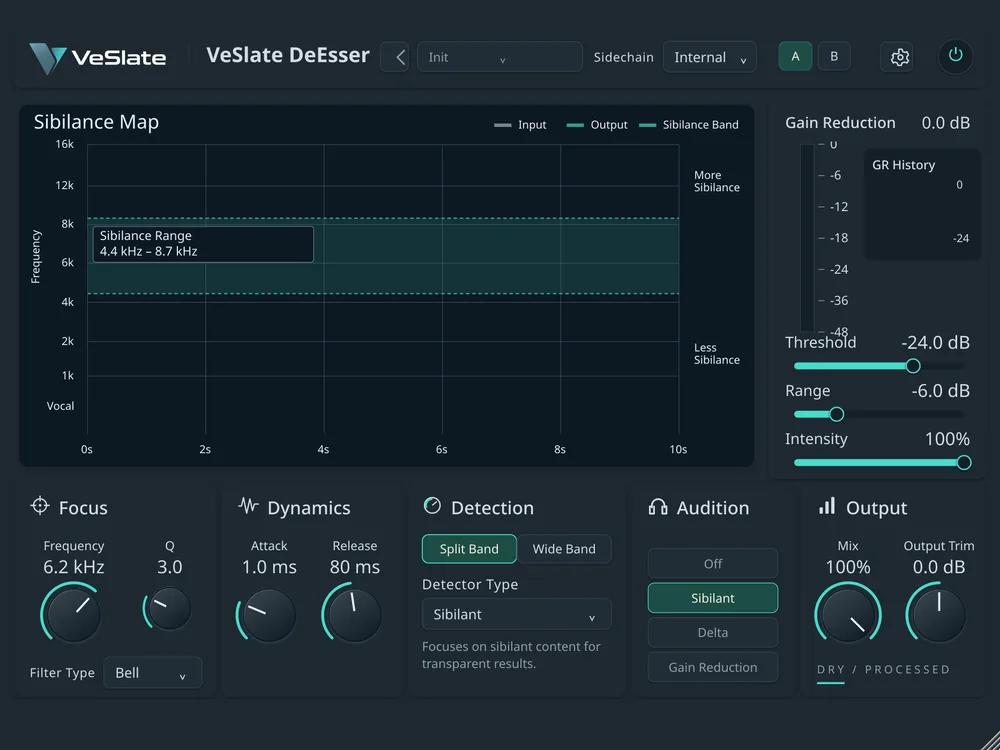
Reduces sibilance at a frequency you set, working on a narrow band or on the whole signal, with threshold, range, attack, release, Q and a mix control. The detector listens to the sibilant band or to the overall level, and can follow an external input.
-
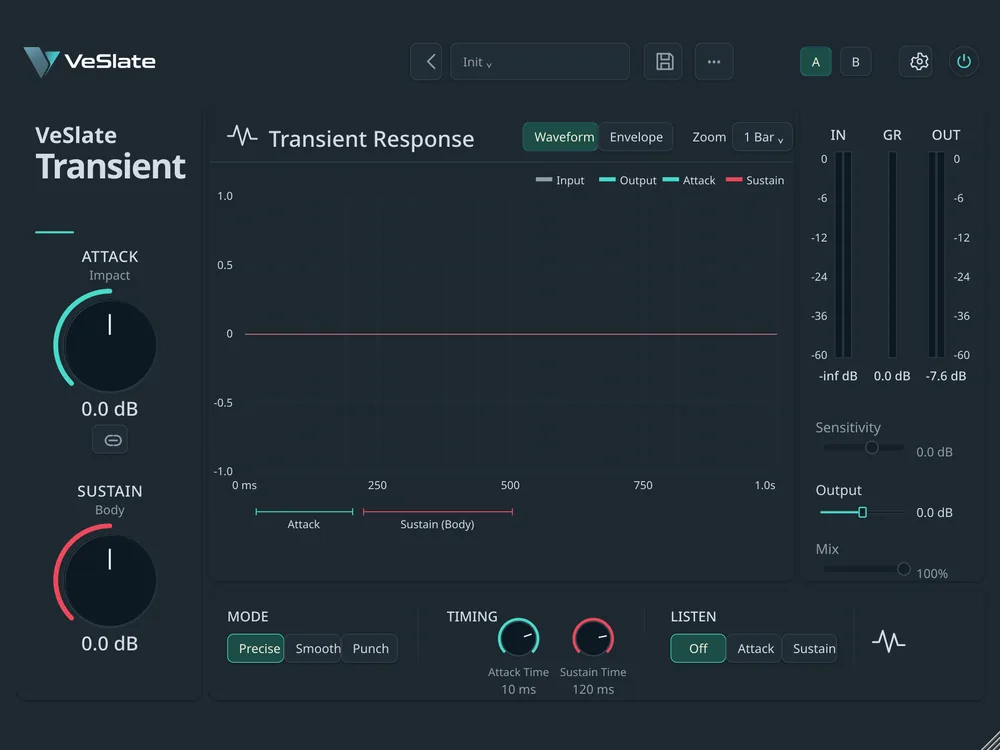 Transient
Changes the attack and the sustain of a sound with two controls, so drums and plucked notes can be given more or less snap. It also has an output level and a bypass.
-
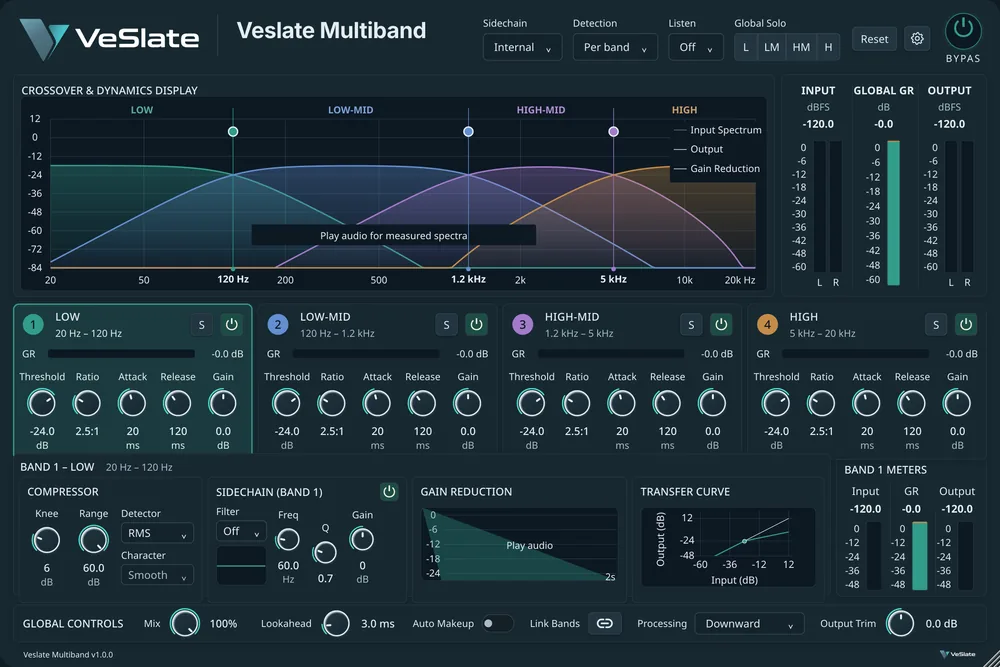 Multiband
Splits the signal into four bands at three crossover frequencies and compresses each band with its own threshold, ratio, attack, release, knee and gain. Each band can be soloed, bypassed or linked, bands can expand upward instead of reducing, and the detector can follow an external input.
EQ and filter
-
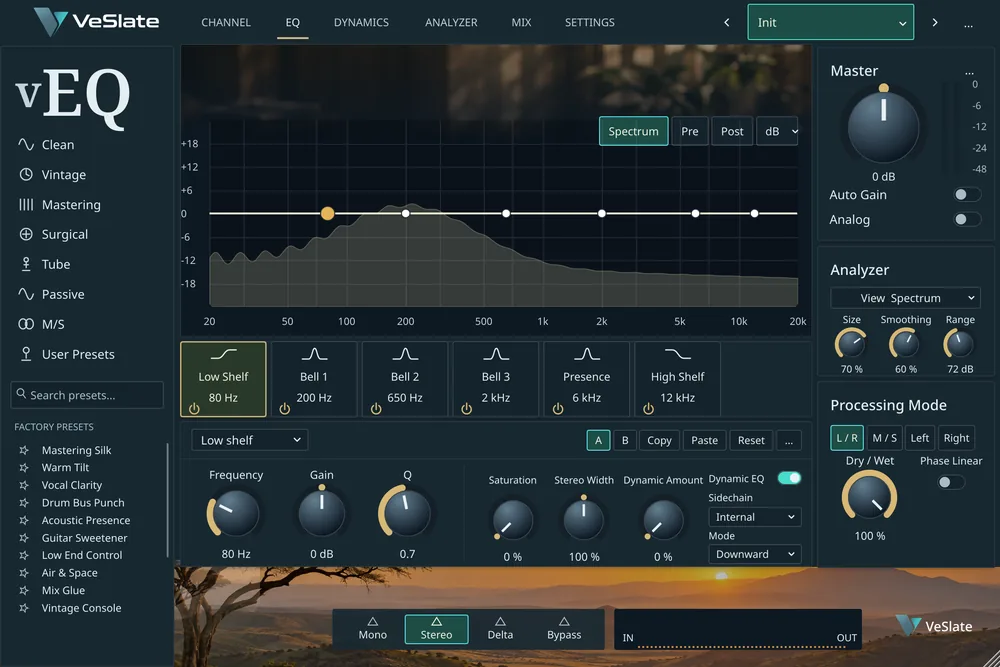 EQ
A six-band parametric equaliser whose bands are bell, low shelf, high shelf, low pass, high pass or notch, each with frequency, gain and Q. The response curve is drawn over a live spectrum, the bands can be dragged on it, and each band can work on the whole image, the middle or the sides and can be soloed.
-
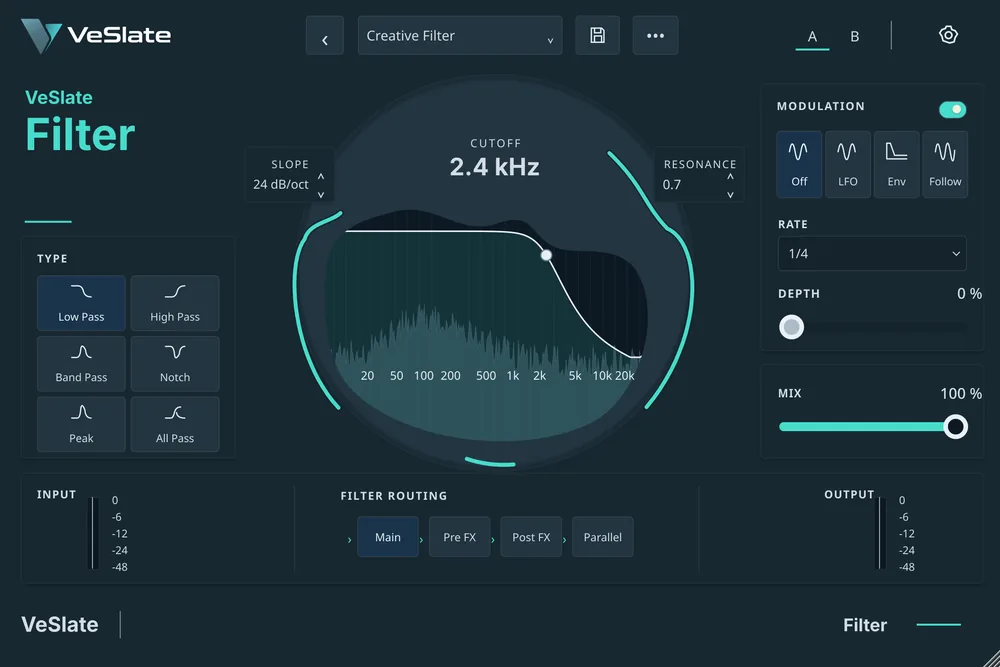 Filter
 is a state-variable filter with low pass, high pass, band pass, notch, peak and all pass modes, one or two stages, a cutoff from 20 Hz to 20 kHz and resonance. A tempo-based LFO, an envelope triggered by the input and an input follower can move the cutoff, and a mix control blends the result with the dry signal.
Space and time
-
 Reverb
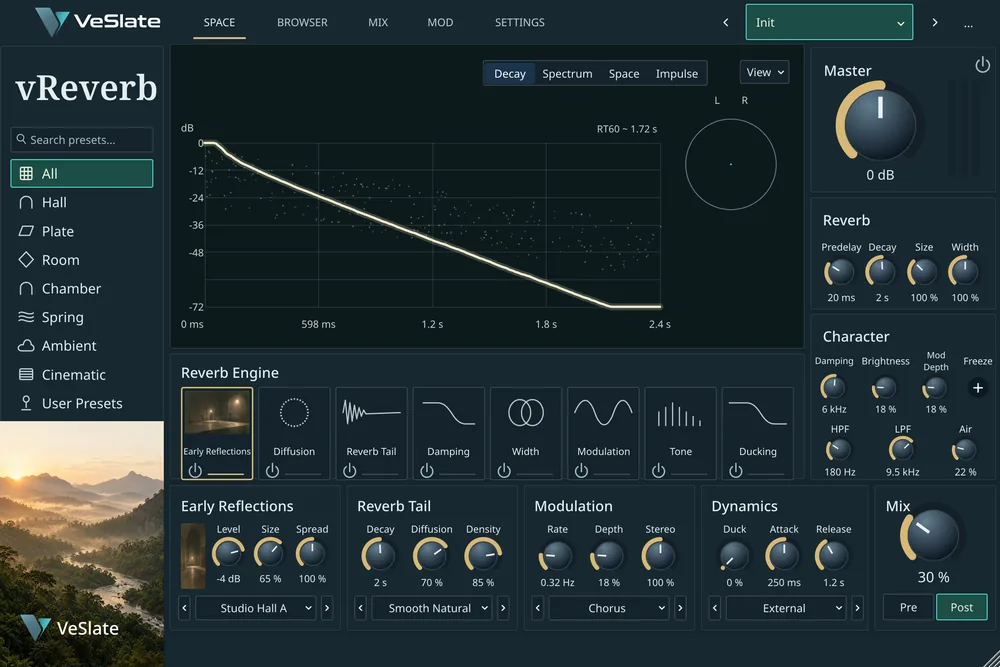
An algorithmic reverb built on eight delay lines with a Householder feedback matrix and two input allpass filters per channel, adding no latency to the dry signal. Its controls are decay, size, damping, predelay, wet mix and stereo width, with freeze and tail modulation.
-
 Space
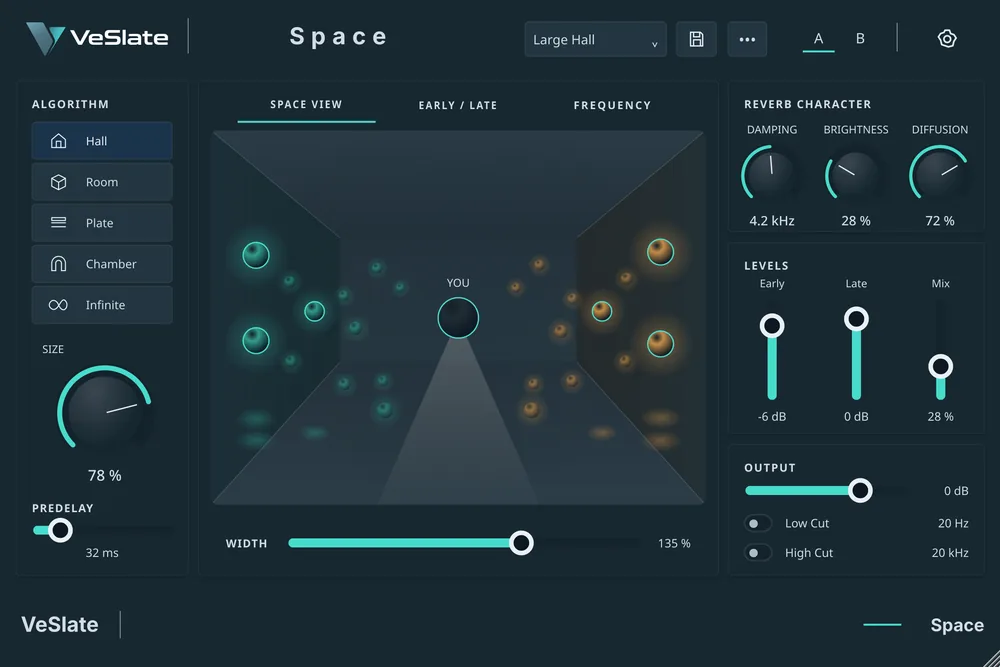
Space is a reverb with Hall, Room, Plate, Chamber and Infinite settings, built from an early reflection field and an eight-line late reverb network. It has size, predelay, damping, diffusion, brightness, early and late levels, width, low and high cuts, and a listener position control.
-
 Shimmer
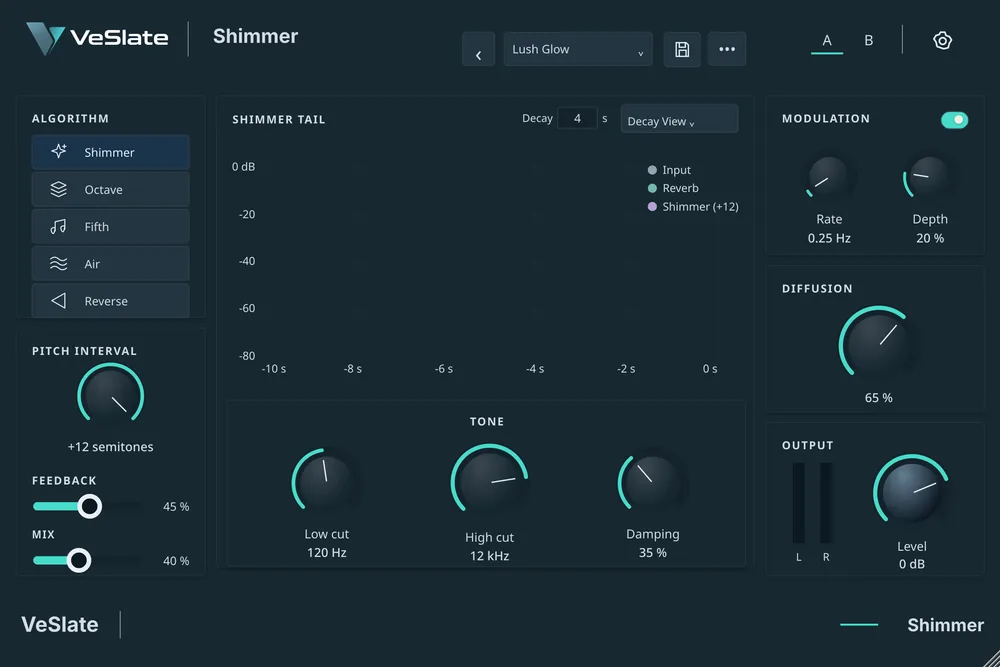
 is a reverb with a pitch shifter in its feedback loop, so each repeat can climb or fall again by the chosen interval of up to 12 semitones either way. It has decay, feedback, damping, diffusion, modulation, low and high cuts, mix and output controls, and five algorithms (Shimmer, Octave, Fifth, Air and Reverse).
-
 Delay
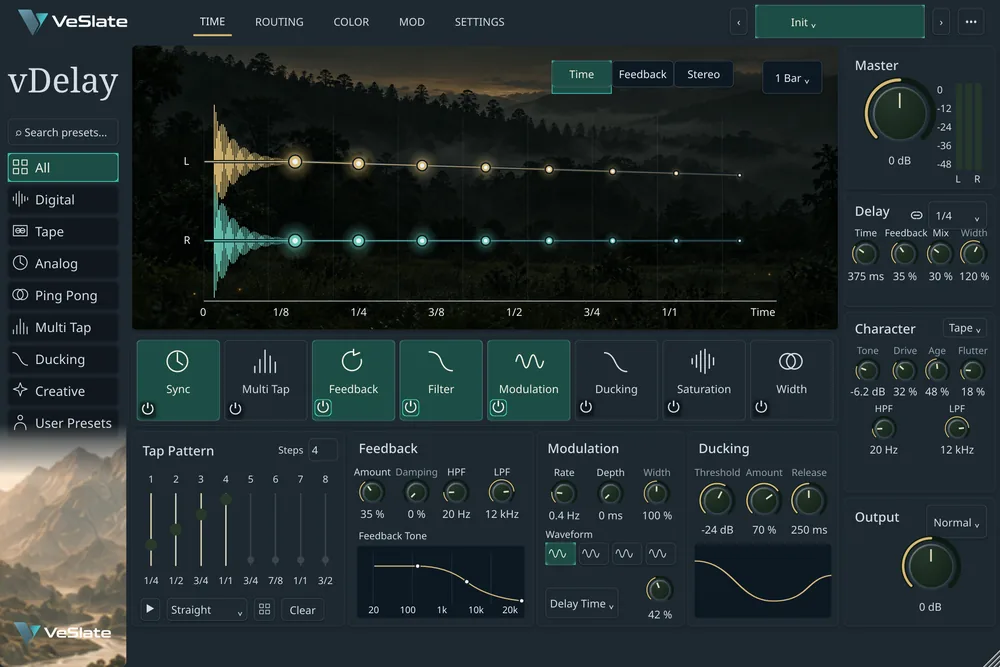
A stereo delay with time set in milliseconds or in note divisions (straight, dotted and triplet), filtered feedback, ping-pong and a stereo offset. It has up to four taps captured from a MIDI note, a modulated read position for chorus-like settings and a pitch shift on each repeat.
Modulation
-
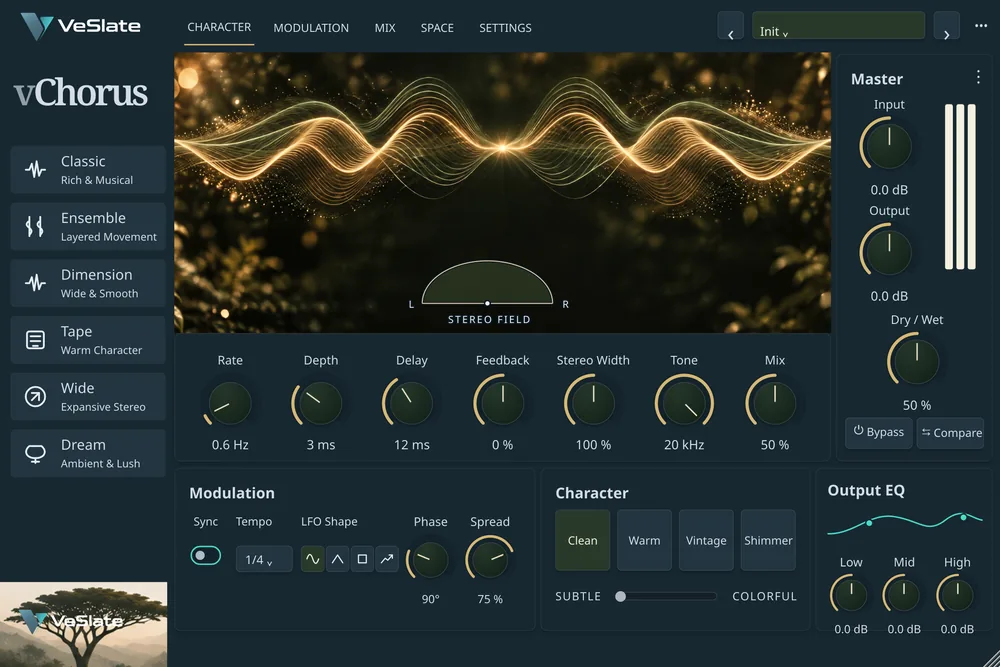 Chorus
 is a stereo chorus and ensemble effect with one to eight voices, each a delay tap modulated by a sine oscillator. It has rate, depth, delay, spread and mix controls.
-
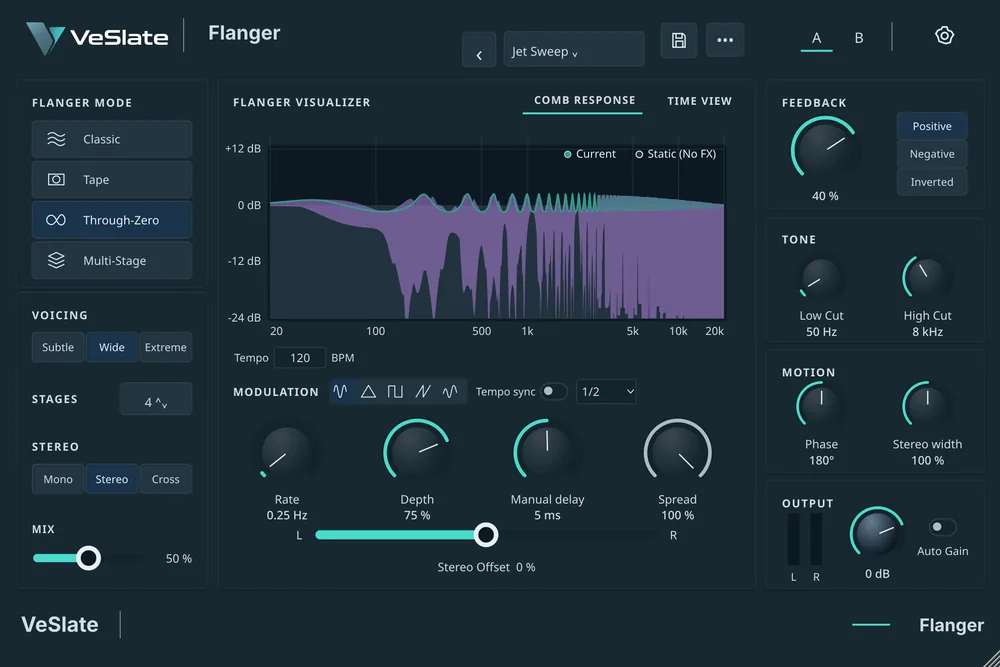 Flanger
 is a stereo flanger with classic and through-zero modes, a delay centre from 0.1 to 10 ms and feedback from minus 95 to plus 95 percent. Its LFO runs free or synced to the host tempo with a sine or triangle shape, and low cut, high cut, width, mix and output controls shape the result.
-
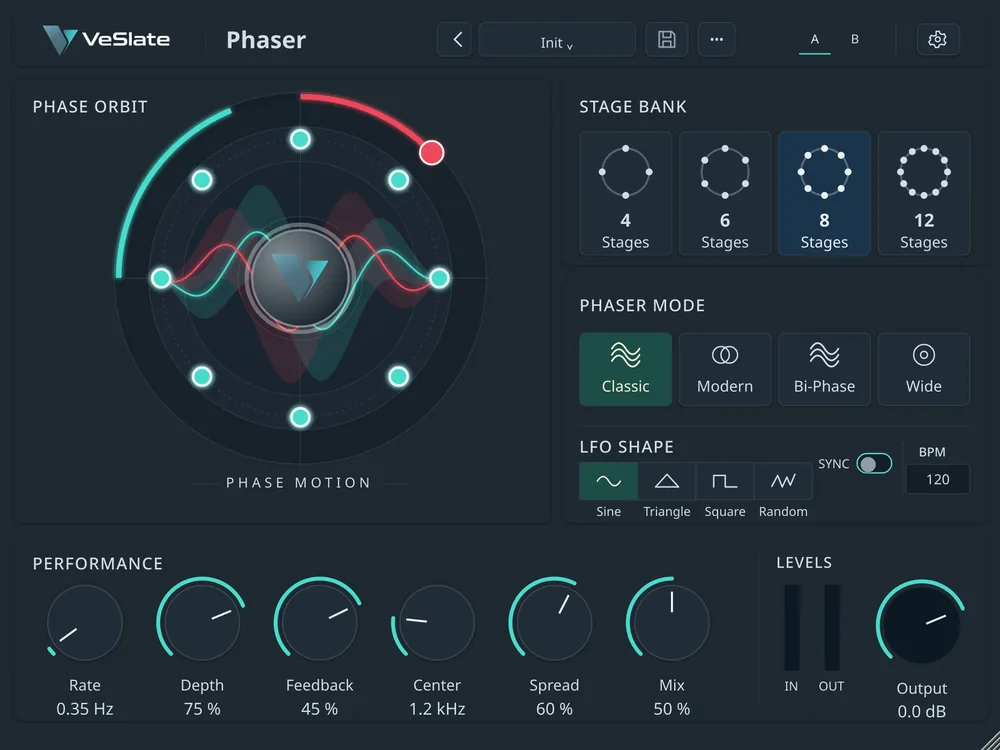 Phaser
 is an allpass phaser with 4, 6, 8 or 12 stages and four modes (Classic, Modern, Bi-Phase and Wide). Its LFO has sine, triangle, square and random shapes, free-running or synced to the host tempo, and there are centre, spread, depth, feedback, mix and output controls.
-
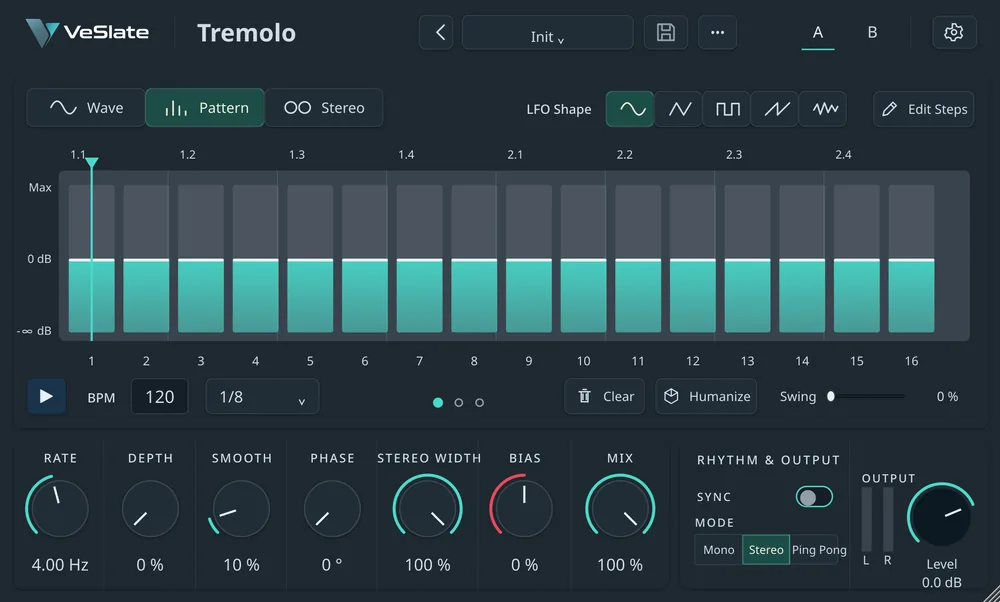 Tremolo
 changes the level of the signal with an LFO (sine, triangle, square, saw or random) or with a 16-step pattern, free-running or synced to the host tempo. It works in mono, stereo or ping pong, with depth, smoothing, phase, width, bias, swing, mix and output controls.
-
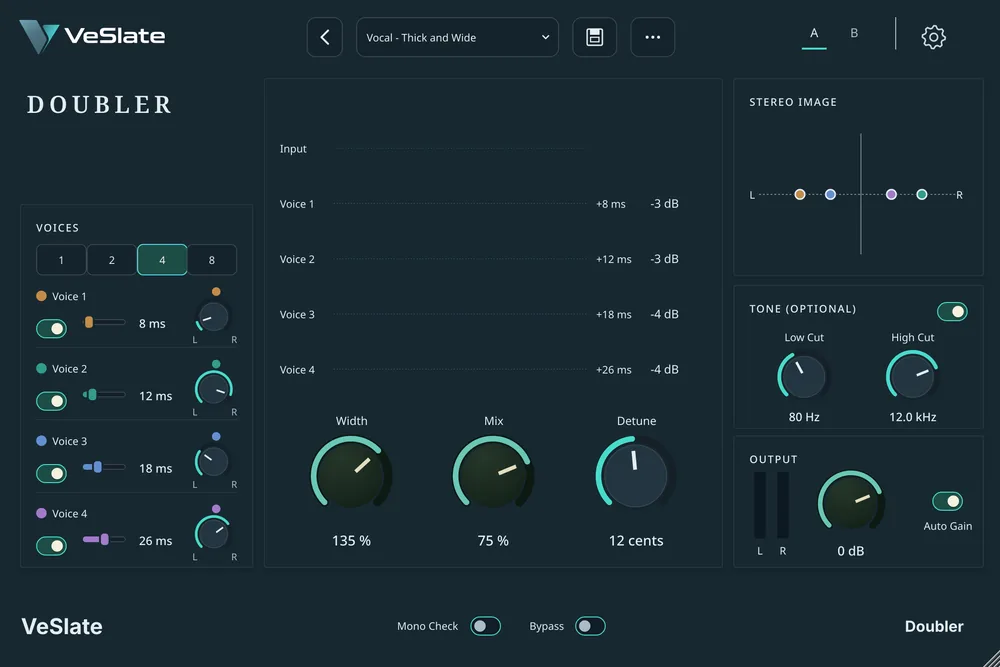 Doubler
Makes one, two, four or eight voices from short delays of 1 to 50 ms and small pitch shifts of up to 25 cents. Width, mix, tone, low and high cut, and output controls shape the result, and the original stereo side is kept.
Tone
-
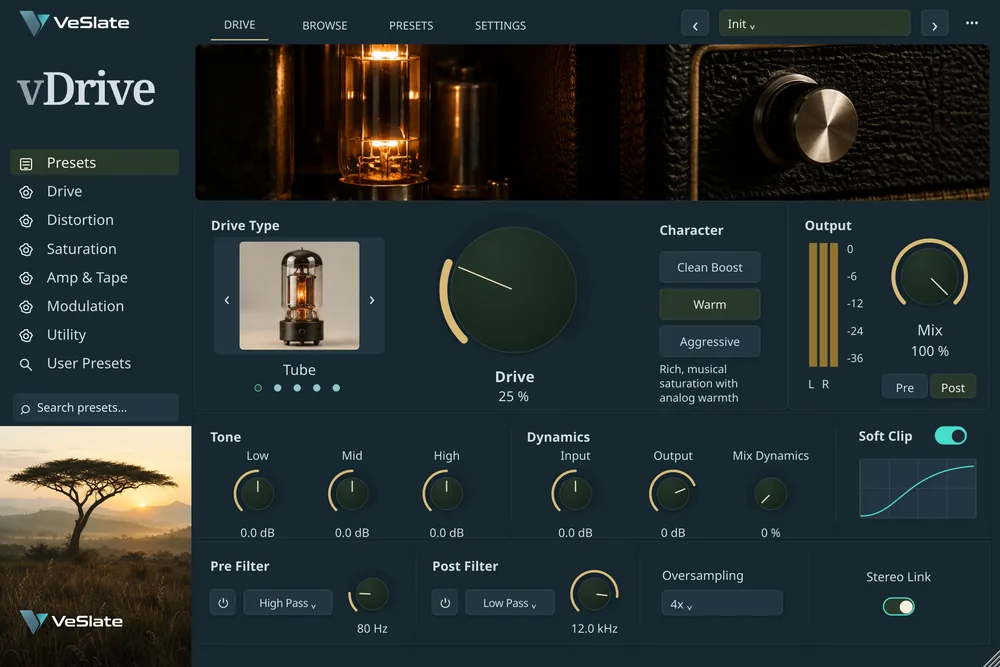 Drive
Drive is a saturator with Tube, Tape, Transistor, Diode and Fuzz types that runs at 4x oversampling. It has input, drive, output and mix controls, low, mid and high tone controls, a parallel compressor, a soft clip, and filters before and after the saturation.
-
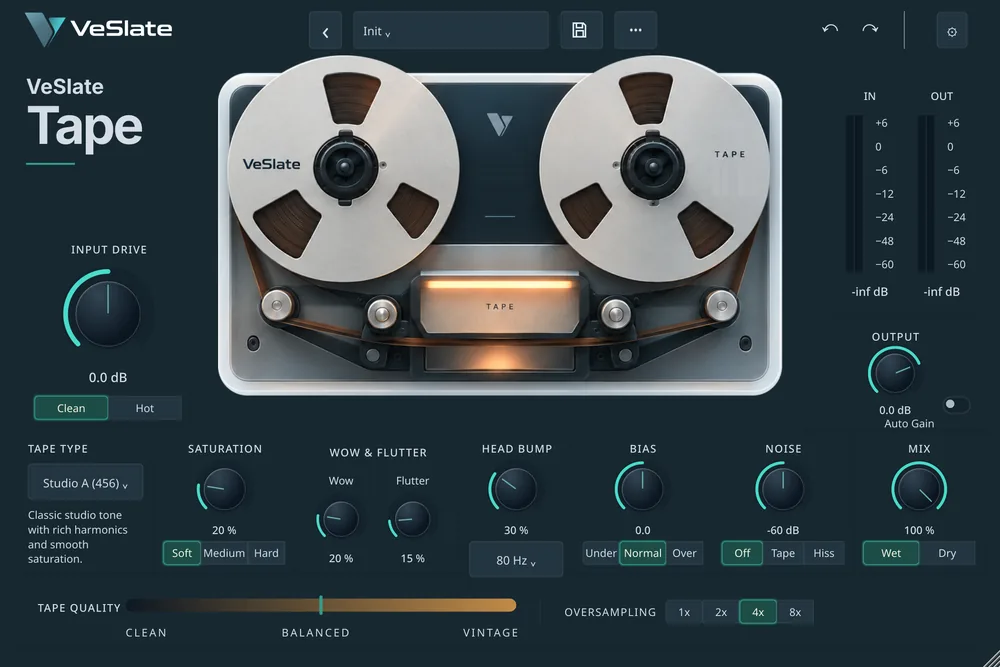 Tape
Tape adds saturation, wow, flutter and a head bump at 80 Hz to the signal. It approximates the character of tape without modelling a machine, adds no noise, and has drive, wow, flutter, bump, mix and output controls.
-
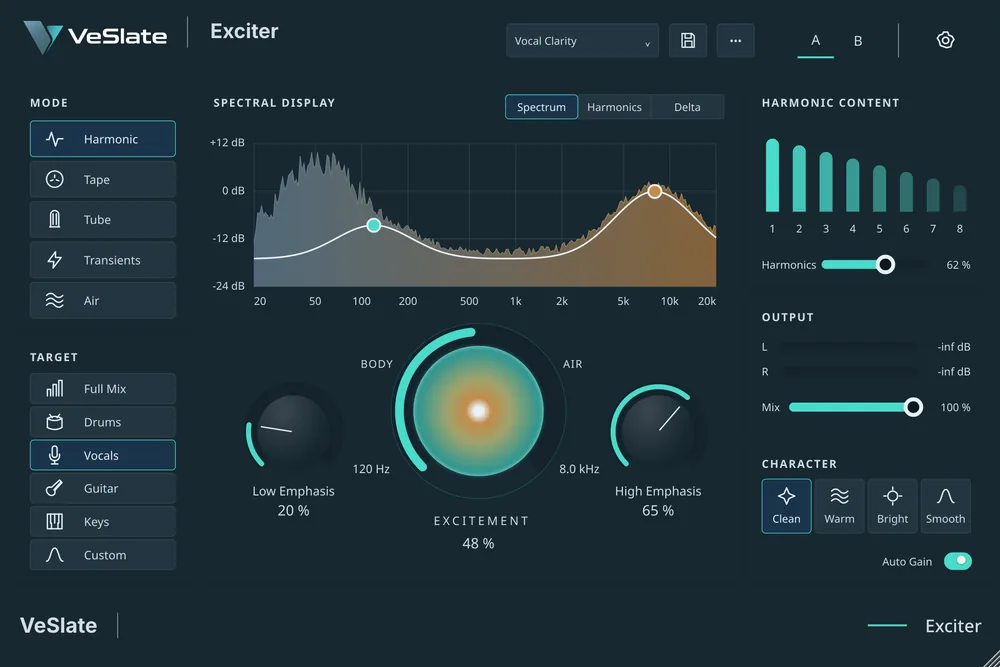 Exciter
 generates harmonics from a body band and an air band and blends them back into the signal. It has five modes (Harmonic, Tape, Tube, Transients and Air), target and character choices, adjustable body and air frequencies, and Excitement, Harmonics, Mix and Auto Gain controls.
-
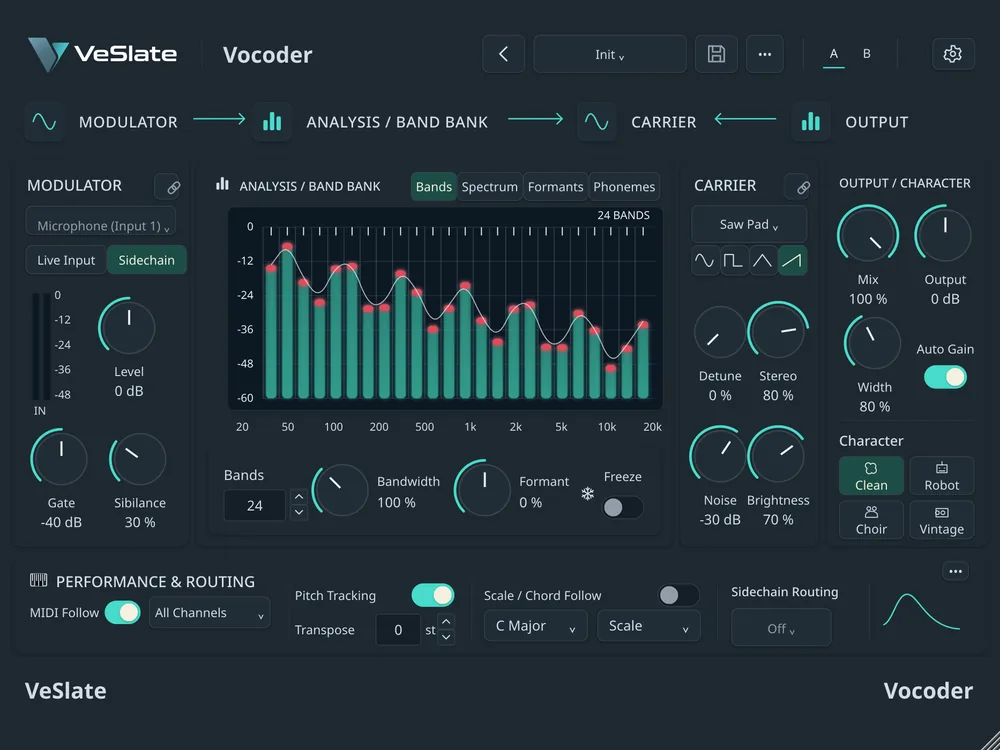 Vocoder
 applies the spectral shape of a modulator, taken from the sidechain input or the live input, to a carrier from an internal oscillator, which MIDI notes or the pitch of the input can play. It has 8, 16, 24 or 32 bands, a formant shift of up to one octave either way, and freeze, gate, sibilance and noise controls.
Pitch and stereo
-
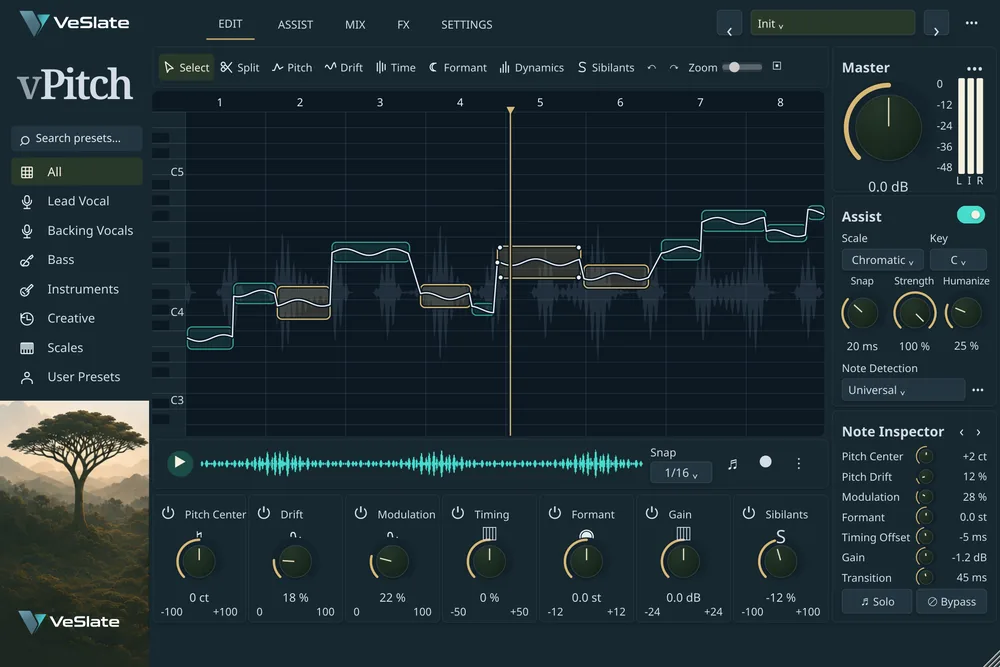 Pitch
Pitch is a pitch corrector for a single voice. It detects the note being sung, moves it to the nearest note of a chosen key and scale or to one target note, and sets how fast the correction arrives, from 0 to 500 ms.
-
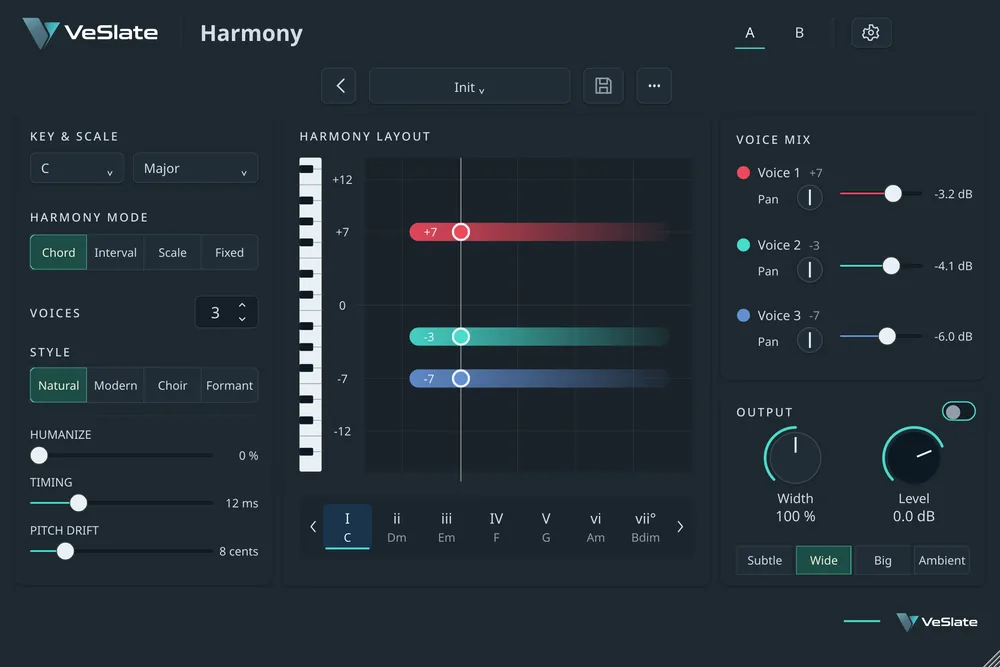 Harmony
 listens to a single voice and adds up to three pitch-shifted voices to it. The voices follow a chord, fixed intervals, a scale or fixed notes in any key, with level and pan for each voice and humanize and timing settings, and there are Natural, Modern, Choir and Formant styles.
-
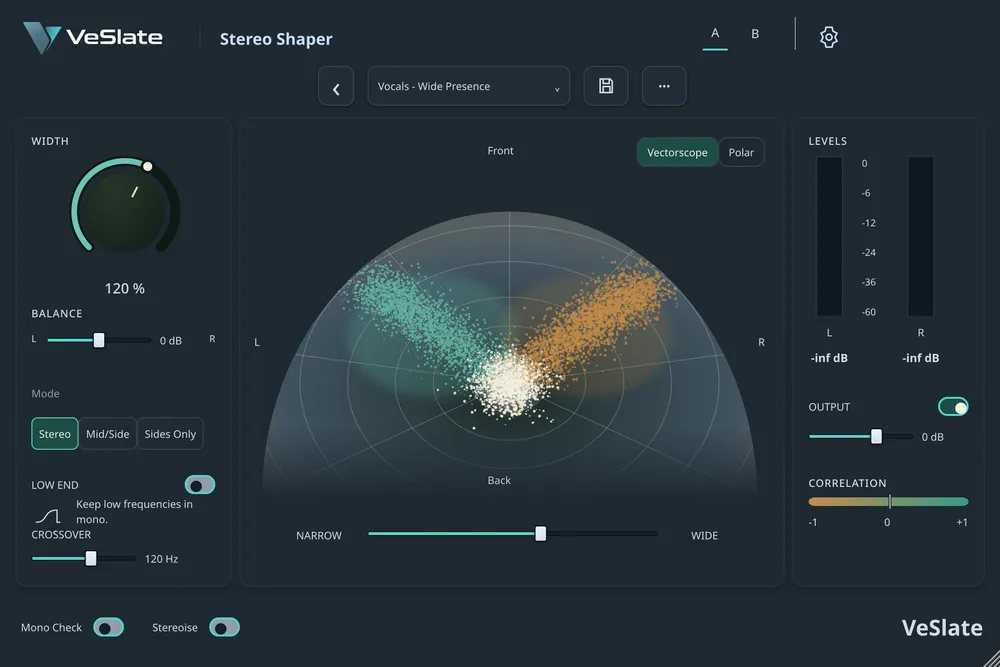 Stereo Shaper
 sets the stereo width of a signal from 0 to 200 percent in Stereo, Mid-Side or Sides Only modes. It also has a left and right balance control, a low-end focus crossover that reduces low-frequency side signal, a Stereoise option and a Mono Check button.
-
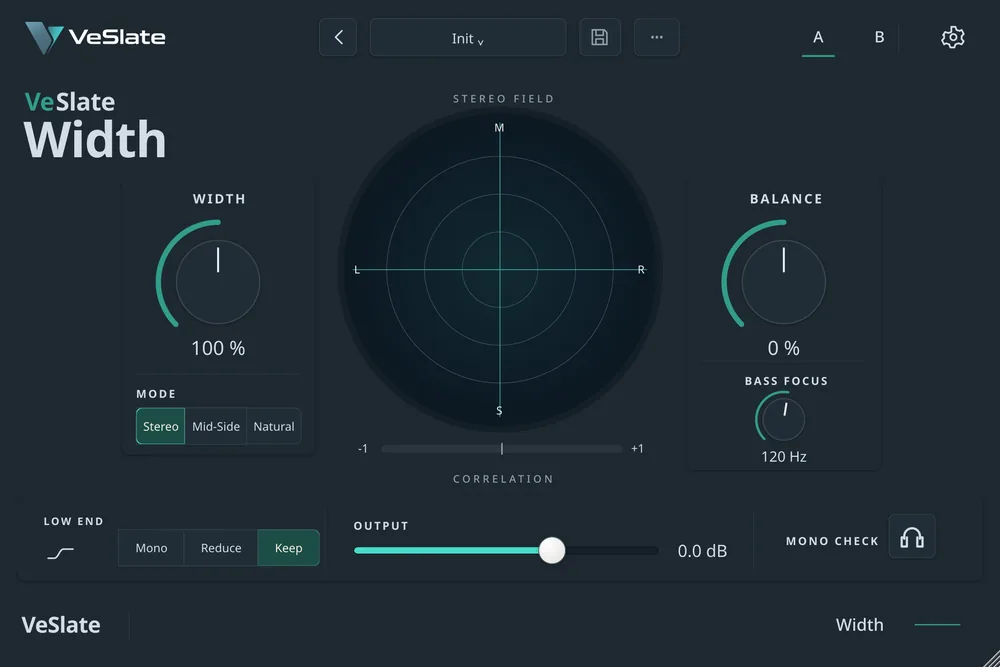 Width
Widens or narrows a stereo signal from 0 % to 200 % in stereo, mid-side or decorrelated mode, with a balance control and an output level. A bass focus control sets the frequency below which the low end is made mono, reduced or kept as it is, and a mono check button sums the output.
-
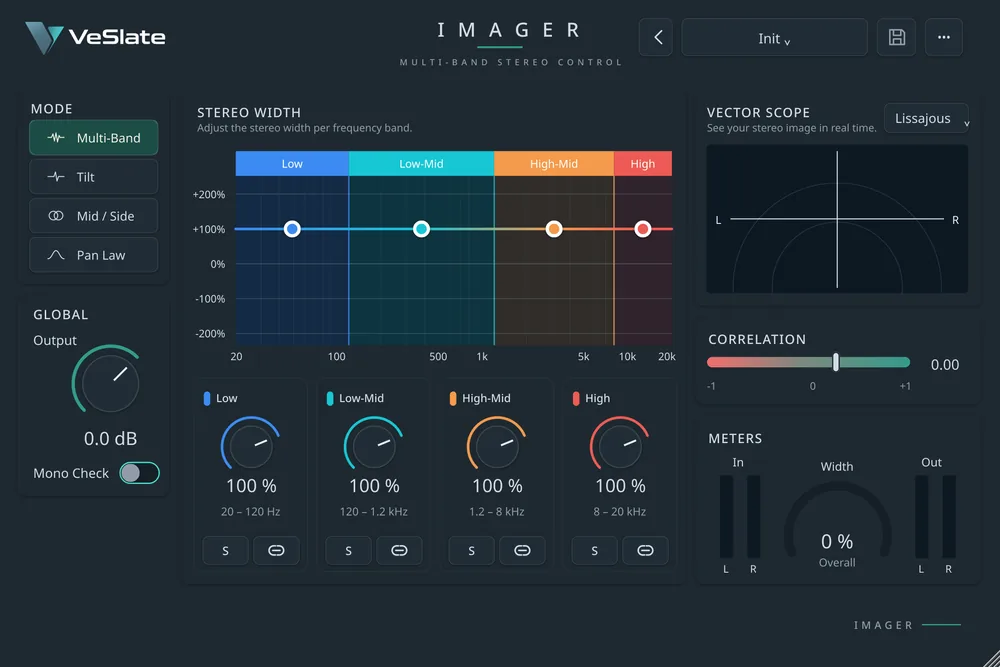 Imager
Sets the stereo width of four frequency bands separately, from -200 % to +200 %, with draggable crossover points and a solo and a link button for each band. It has Multi-Band, Tilt, Mid / Side and Pan Law modes, a vector scope with three views, a correlation meter and input, output and width meters.
Utility
-
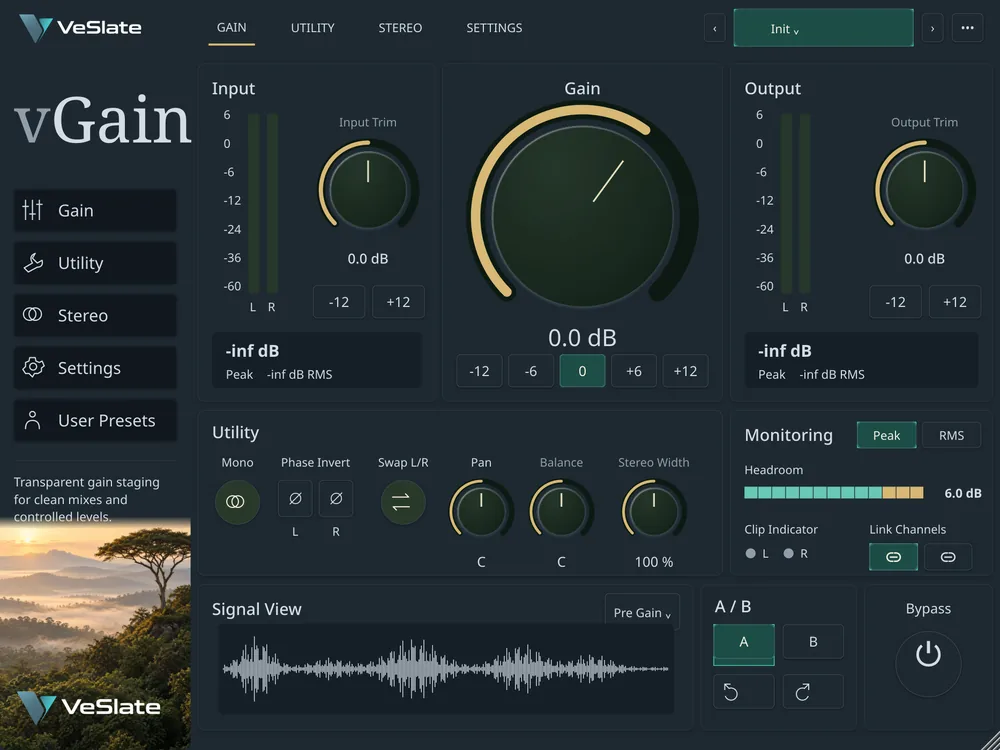 Gain
Sets the level of a track from -60 dB to +12 dB and places it in the stereo field with a constant-power pan. It has a bypass and no other controls.
-
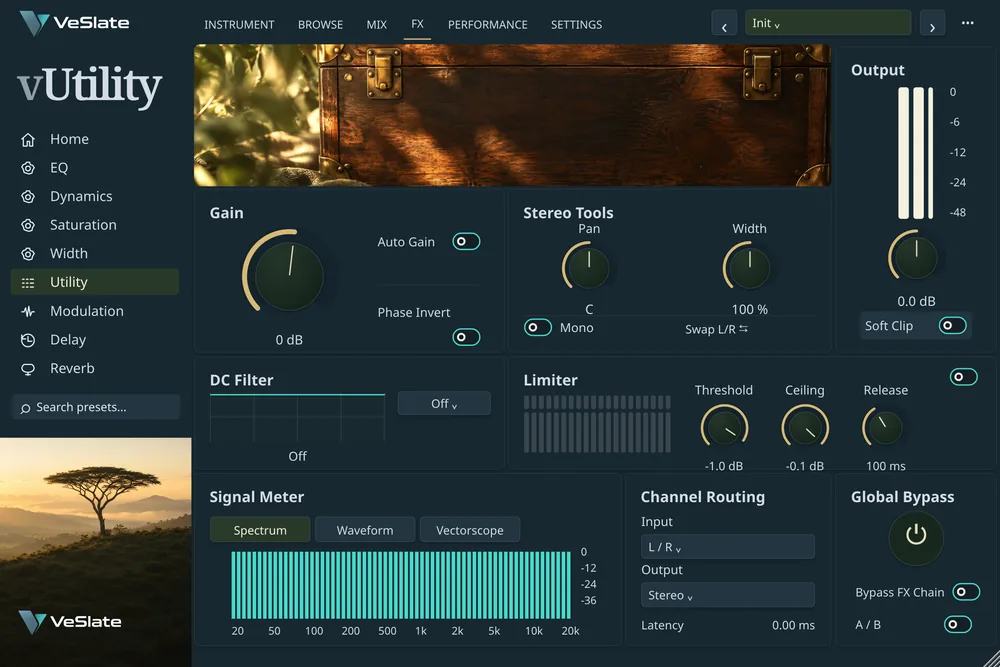 Utility
 is a channel tool with gain, polarity invert for each side, a delay of up to 1000 samples, width, pan with a choice of pan law, and bass summed to mono below a set frequency. It also has input routing, a DC filter, a soft clip, a limiter, auto gain, and a Listen control for stereo, mono, left, right, mid, side and swapped views.
-
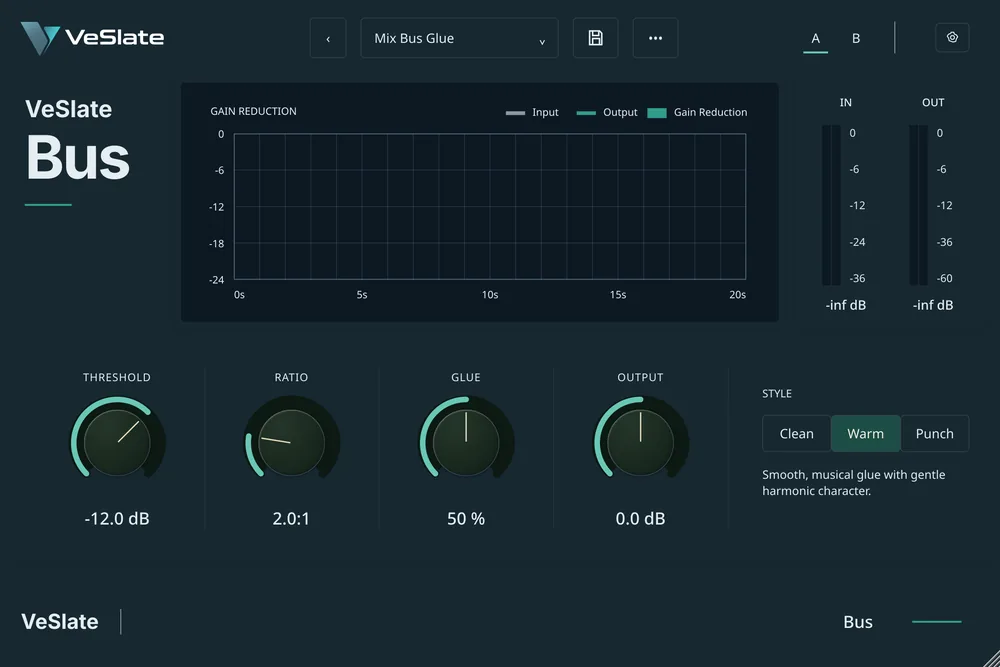 Bus
Bus is a compressor for mixes and drum buses with a 6 dB soft knee, ratios from 1.5:1 to 4:1, and threshold and output controls. A Glue control blends in a slowly accumulating recovery memory, and the Clean, Warm and Punch styles change its timing and colour.
-
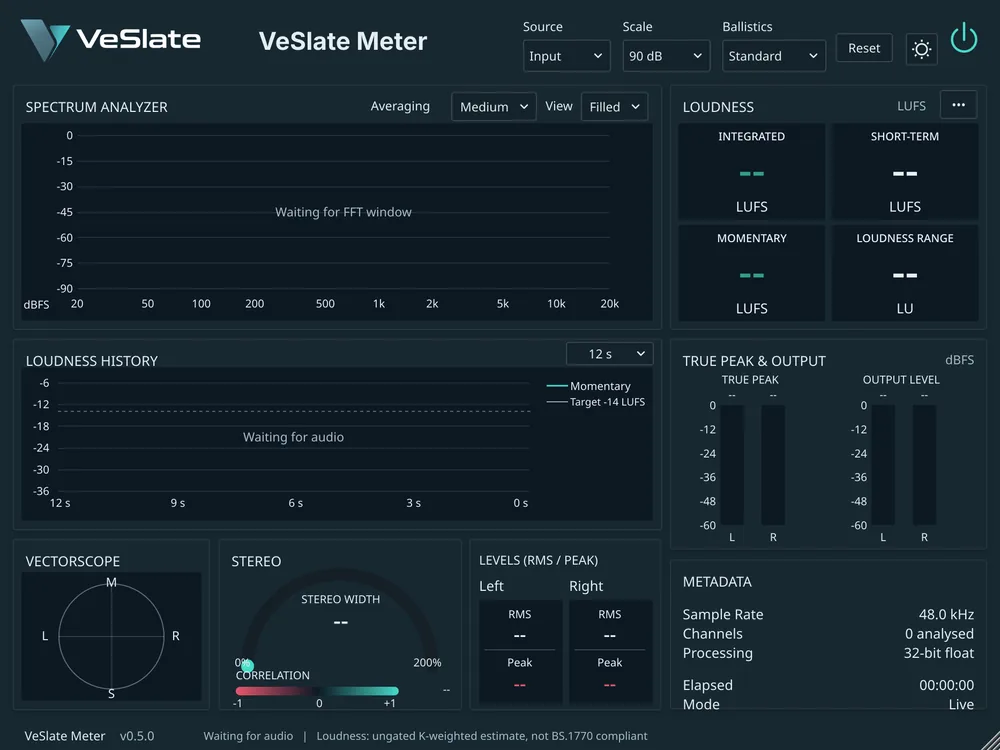 Meter
Passes audio through unchanged and measures it, with a choice of source (input, left or right), a scale of 60, 90 or 120 dB and fast, standard or slow ballistics. It shows loudness estimates for the momentary, short-term and integrated readings without gating, so they are not for certifying delivery loudness.